

Early Orthodontic Treatment Course for Sound Decisions in the Mixed Dentition
With the early orthodontic treatment course, you gain the confidence to treat children in the mixed dentition yourself instead of referring them out of uncertainty. A lot is decided between the ages of six and twelve. Will the mandible keep growing asymmetrically with a crossbite, or will a sucking habit open the bite for good? If you miss this window, later treatment often becomes longer and more complex.
Dr. Dr. Martin Baxmann built the early orthodontic treatment course on his LEAN ORTHODONTICS® system, refined over more than two decades in his own practice and in teaching. Clinicians from many countries, more than 1,864 so far, have attended his courses. The early treatment course applies this logic to the youngest patients in your practice. Afterwards, you classify findings reliably, choose the right appliance and deliberately keep the active phase short.
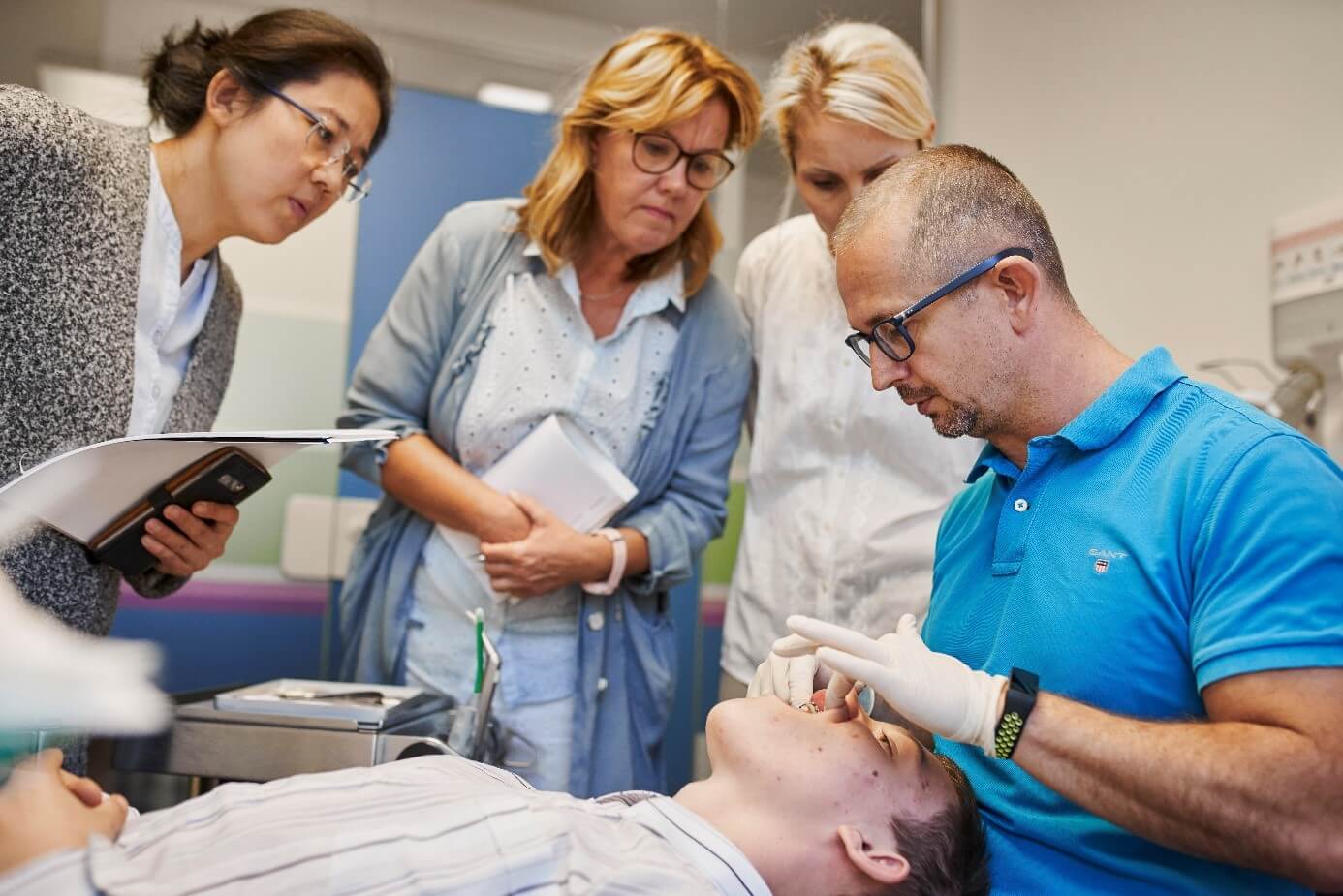
Instead of theory on slides, the one-to-one format centers on cases from your own clinic. You apply what you discussed at the chair before the next appointment. This turns the early orthodontic treatment course from a mere knowledge update into a permanent part of your treatment spectrum.
Spotting Crossbite, Mandibular Prognathism and Space Deficiency Early
Which findings truly belong in early treatment, and which can you calmly monitor? The early orthodontic treatment course starts with exactly this question, because a clean indication saves the child wear time and saves you chair time. Typical candidates for early intervention are:
- Lateral crossbite with functional shift, because otherwise the mandible can grow asymmetrically
- Anterior crossbite and mandibular prognathism, as long as the maxilla can still be developed forward well
- Markedly increased overjet, which exposes the upper incisors to a higher risk of trauma
- Premature loss of primary teeth, where space for the permanent teeth is lost without a space maintainer
- Sucking and tongue habits that promote an open bite
Behind each of these findings lies its own mechanics, from rapid maxillary expansion to the face mask to the simple space maintainer. To help you use these tools purposefully, the interceptive orthodontics course links each indication to a measurable treatment goal. An expansion, for example, only counts as complete once the functional shift has disappeared and the mandible closes centrally again.
This list of indications is part of the core program that any good early orthodontic treatment seminar should cover. We go one step further, though. You bring photos, models and findings of your young patients to the calls. As a result, the early orthodontic treatment course never works with invented textbook examples.
Step by Step From Findings to Appliance in the Early Treatment Course
The course follows a fixed sequence of findings, diagnostics, goal, appliance and monitoring. First, you use models, photo documentation and a clinical functional analysis to clarify whether an X-ray is needed at all. Then you define the goal and end point of the measure. A clear stopping criterion prevents a short early phase from turning into years of continuous treatment.
Only then does the appliance come into play. You justify every appliance, from the expansion plate to the face mask, on the specific child in the early orthodontic treatment course. For removable appliances, you plan compliance in from the start, for example via short wear-time checks and small milestones that even eight-year-olds understand. In addition, the Orthodontic Course shows how the early phase later transitions into Class II therapy, aligners or fixed appliances.
Where the Early Orthodontic Treatment Training Draws Clear Lines
In the early orthodontic treatment course, you learn that not every irregularity in the primary or mixed dentition justifies an appliance. Cochrane reviews show, for example, that an early Class II phase mainly reduces the risk of incisor trauma but rarely improves the final result beyond that. That is why the early orthodontic treatment training openly says when waiting is the better therapy.
We use this orientation as a starting point:
| Lateral crossbite with functional shift | correct early |
| Anterior crossbite or mandibular prognathism | check early while the maxilla is growing |
| Overjet with increased trauma risk | reduce early |
| Class II without trauma risk | usually treat during the pubertal growth spurt |
| Mild anterior crowding | monitor the tooth transition |
Honest limits protect you from overtreatment, disappointed parents and unnecessary costs. Your scheduling stays lean because no early cases linger in recall for years. Especially with parents who have already sought a second opinion, a well-reasoned recommendation to wait strengthens trust in your practice. That is why you also practice the justified no in the early orthodontic treatment course.
Would you like to get a broader overview first? A compact early treatment seminar is a good way to raise the topic together with your team. Our Orthodontic Seminar shows you which clinical focus areas we teach beyond that.
How Do You Explain to Parents Why Now Is the Right Time?
Parents often see only small baby teeth and wonder why their child should already wear braces. Your answer decides whether they agree and whether the child later wears the appliance reliably. In the early orthodontic treatment course, you therefore practice showing the family with photos and models what would happen without intervention. An understandable prognosis convinces more than any technical term.
Early orthodontic treatment training that leaves out the parent consultation remains only half effective in daily practice. To help you with conducting parent consultations professionally, we go through typical objections around wear time, costs and timing with you in advance.
We developed our conversation guides across the five Orthodentix® locations, where early treatment is part of the daily routine. The foundation is the LEAN ORTHODONTICS® book series, whose volumes became Amazon bestsellers and whose way of thinking shapes the early orthodontic treatment course. Dentist Dr. Elen Ho describes the method as "simple, comprehensible and learnable". In 2019, the approach was also recognized with a European Business Award.
Whether the early orthodontic treatment course works better as three-month Performance Coaching or within Excellence Coaching 365 is something we clarify in the free planning call. For questions between the Zoom calls, you also have your own VIP WhatsApp group. Book the call directly via Book Free Consultation, so the early orthodontic treatment course arrives in your practice this quarter.
Jetzt Erstgespräch vereinbaren